Why Websites Don't Convert Anymore
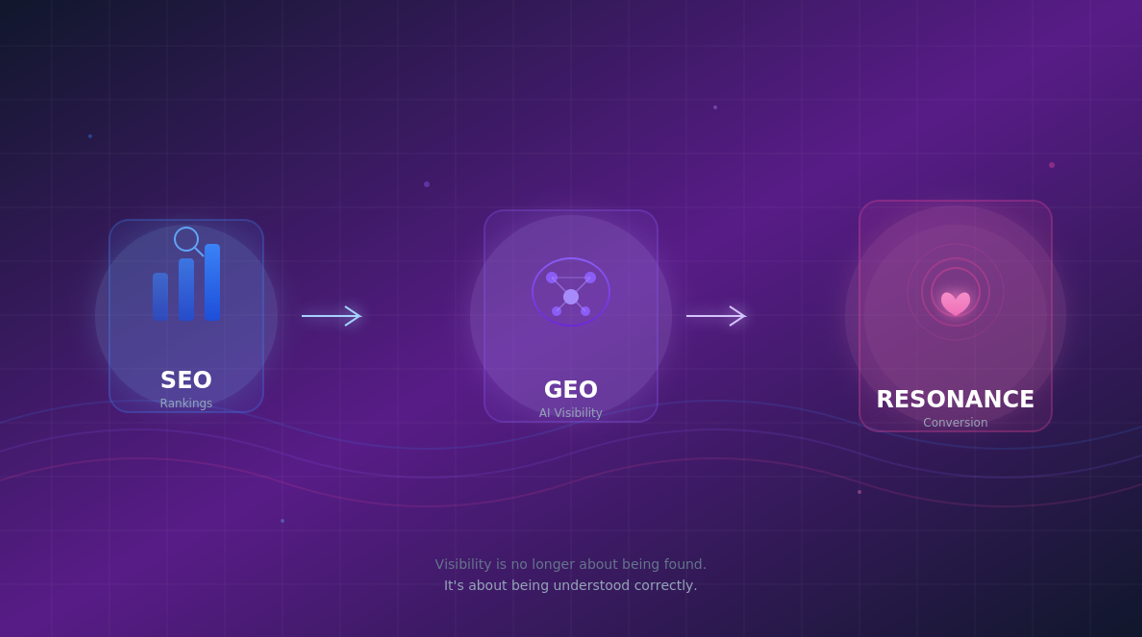
From SEO to GEO: The New Era of Resonance-Based Visibility
📌 TL;DR
Traffic is not the problem anymore—misalignment is. SEO brought rankings, GEO brought AI visibility, but Resonance brings conversion. In the AI era, your website may be visible but not felt. Brands that win are those that are easy to understand, easy to explain, and emotionally coherent. ECHO Platform measures what analytics tools miss: how your message sounds when it comes back.
Traffic is not the problem anymore. Misalignment is.
For years, website optimization focused on rankings, keywords, and backlinks. But something changed.
Websites still get traffic. Yet conversions keep dropping.
So what's really happening?
The answer lies in a new shift: From SEO to GEO — and beyond that, to Resonance.
The Silent Shift: How AI Changed Search Behavior
Search is no longer just "search."
Today:
- Google shows AI-generated answers
- ChatGPT summarizes websites instead of sending clicks
- Users trust interpretation over raw information
- 60% of searches now end without a click
This creates a new reality:
Your website may be visible, but not felt.
AI doesn't just scan keywords. It evaluates clarity, intent, coherence, and emotional signal.
And that's where most websites fail.
SEO vs GEO: What's the Real Difference?
Traditional SEO Generative Engine Optimization (GEO) Keyword-focused Meaning-focused Page-level optimization Context-level optimization Rankings matter Extractability matters Click-based success Citation-based success "Is it optimized?" "Is it understandable?" GEO asks a different question:
Can an AI clearly understand what this website is about — and confidently explain it to a human?
If the answer is no, visibility becomes meaningless.
The Missing Layer: Resonance
Even GEO is not enough.
Because humans don't convert based on clarity alone. They convert based on connection.
This is where Resonance Optimization comes in.
Resonance answers three deeper questions:
- Does the message emotionally align with the visitor?
- Does the brand feel trustworthy, intentional, and coherent?
- Does the experience create a sense of "this is for me"?
Most analytics tools can't measure this. But users feel it instantly.
Research shows: Websites with strong brand coherence see 2-3x higher conversion rates compared to those with fragmented messaging.
Why High Traffic Websites Still Don't Convert
From our resonance-based analyses, the most common issues are:
- The message is technically correct but emotionally flat
- The value proposition is generic
- The tone doesn't match the target audience
- Pages explain what but fail to convey why it matters
- AI summaries distort or oversimplify the brand message
In short:
The website speaks — but the echo comes back distorted.
Introducing ECHO Platform: Measuring What Others Miss
ECHO Platform was built for this exact moment.
Instead of asking:
- "Is this page optimized?"
We ask:
- "What does this page sound like when reflected back?"
ECHO Platform analyzes:
- Message clarity vs perceived meaning
- Brand coherence across pages
- Emotional signal strength
- AI interpretation gaps
- Resonance score across human + AI perception layers
Because in the AI era, perception is reality.
The Future of Visibility Is Interpretability
Search engines will continue to evolve. AI will continue to summarize, filter, and reinterpret.
Websites that win will be the ones that:
- Are easy to understand
- Are easy to explain
- Are emotionally coherent
- Create clean echoes, not noise
Visibility is no longer about being found. It's about being understood correctly.
Frequently Asked Questions
What is GEO (Generative Engine Optimization)?
GEO is the practice of optimizing content so AI systems can accurately understand, summarize, and cite it in their responses. Unlike traditional SEO which focuses on rankings, GEO focuses on making your content extractable and interpretable by AI platforms like ChatGPT, Perplexity, and Google AI Overviews.
How is Resonance different from SEO and GEO?
SEO focuses on search rankings and traffic. GEO focuses on AI interpretability and citations. Resonance goes deeper—it measures emotional alignment, brand coherence, and conversion potential. You can rank well and be cited by AI, but still fail to convert if your message doesn't resonate.
Why do high-traffic websites fail to convert?
Most websites are technically optimized but emotionally flat. They explain "what" the product does but fail to convey "why it matters" to the visitor. The message may be clear to search engines but doesn't create the emotional connection needed for conversion.
How does ECHO Platform measure resonance?
ECHO Platform analyzes your brand across four dimensions: Engagement Message, Core Source, Harmonic Target, and Outreach Channel. It measures the gap between what you intend to communicate and what AI systems (and humans) actually perceive—revealing where your message gets distorted.
Can improving resonance also improve SEO and GEO?
Yes. A resonant message is naturally clearer and more coherent, which benefits both traditional search rankings and AI interpretability. Resonance optimization creates a foundation that amplifies all other visibility efforts.
Final Thought
SEO brought traffic. GEO brought AI visibility. Resonance brings conversion.
And the brands that understand this shift early won't just rank — they'll connect.
Want to see how your website actually resonates?
Run a free Echo Resonance analysis and hear what your message sounds like when it comes back.
Start Free Analysis →
Giray
Founder of ECHO Platform & creator of the ECHO Framework. 15+ years in digital marketing, author of "Marketing Resonance". Helping brands achieve true resonance with their audiences through AI-powered intelligence.